
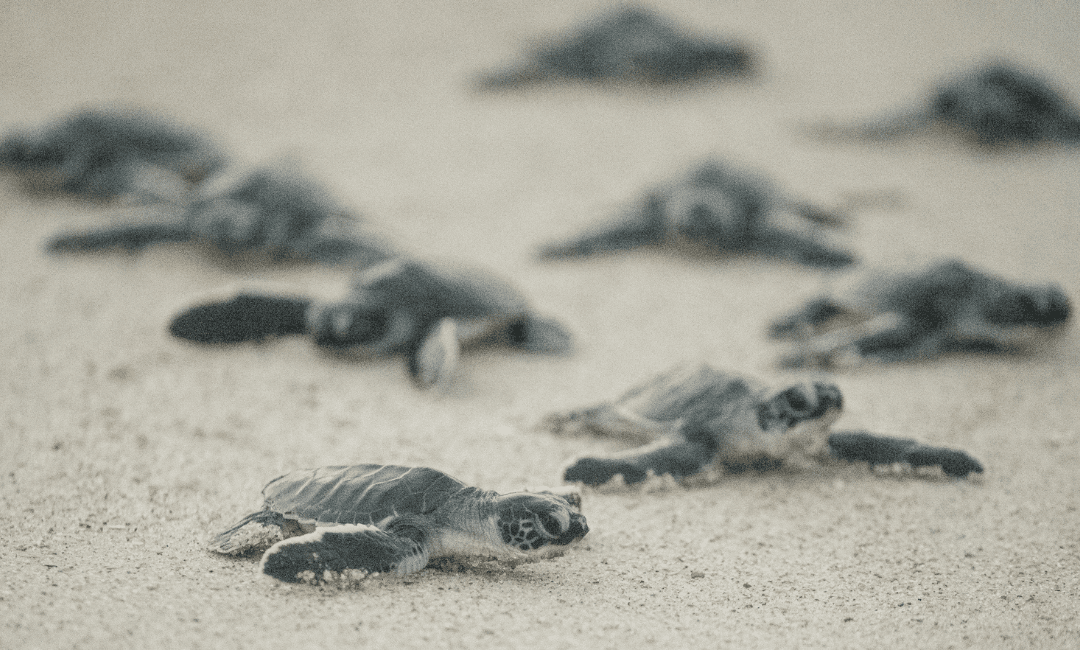
Every May, something extraordinary happens along Collier County’s coastline. Under the cover of darkness, female sea turtles — some weighing over 300 pounds and having traveled hundreds of miles — haul themselves ashore to nest on the same beaches where they were born. It is one of nature’s most remarkable acts of loyalty. And it is one we can either protect or put at risk.
Florida hosts the largest loggerhead sea turtle nesting population in the world, and Collier County’s beaches are part of that legacy. According to the Florida Fish and Wildlife Conservation Commission (FWC), the primary sea turtle nesting season in Florida runs from May through October.
What does any of this have to do with litter? Everything.
Litter Is a Life-or-Death Issue for Sea Turtles
When a female sea turtle emerges from the water at night, she navigates almost entirely by light and the slope of the sand. Beach furniture left out after dark, scattered debris, and even the glow of artificial lighting can disorient her, causing her to abandon her nesting attempt and return to the sea, sometimes repeatedly, before her eggs must be laid. Hatchlings face the same danger. Drawn naturally toward the brightest horizon (historically, the moonlit sea), they can instead turn toward inland lights and never reach the water.
Plastic debris poses an even longer-term threat. NOAA has documented that more than 700 species of marine wildlife — including all five species of sea turtles found in U.S. waters — have been confirmed to ingest plastic or become entangled in marine debris. To a sea turtle, a floating plastic bag is nearly indistinguishable from a jellyfish, a primary food source. Ingestion can cause internal blockages that are fatal.
According to national research by Keep America Beautiful, nine out of ten pieces of litter are under four inches in size — the kind of small fragments that are hardest to see and easiest to overlook on a beach. Cigarette butts, bottle caps, straw wrappers, and plastic film may seem trivial, but at the water’s edge, they become part of a marine debris problem that spans the entire Gulf of Mexico.
What Collier County Volunteers Can Do Right Now
The good news is that the actions that protect sea turtles are the same habits that protect all of Collier County’s coastal waters — and they start with each of us.
During nesting season (May–October), beach visitors and residents can help by removing all belongings, furniture, and equipment from the beach before dark; using turtle-friendly, amber-toned lighting if you live or stay beachside; filling in any holes dug in the sand before you leave; and picking up every piece of litter you can carry out, no matter how small.
Rookery Bay National Estuarine Research Reserve — which protects 110,000 acres of land and water and encompasses roughly 40% of Collier County’s coastline — is among the protected habitats where this stewardship directly benefits nesting wildlife. When we clean our beaches, we are protecting one of the most ecologically significant stretches of coastline in the southeastern United States.
Sea turtles have been navigating these shores for more than 100 million years. With a little care — and a little less litter — we can make sure they keep coming back.