

If you have seen an orange-headed agama lizard running through a parking lot or a dense stand of red-berried Brazilian pepper bordering a canal, you have already encountered invasive species. Many are so prevalent in our environment that most folks don’t know that they are nonnative, and passing one becomes an everyday occurrence. These plants and animals can often be spotted in residential areas, where they may have been introduced, and native flora and fauna have been displaced, allowing them to fill an empty ecological niche. An invasive species is a nonnative organism introduced by humans that causes harm to the environment, human health or the economy.
In Florida, invasive species represent a significant environmental and financial challenge. The Florida Fish and Wildlife Conservation Commission annually spends approximately $45 million annually on invasive plant management statewide, affecting more than 1.5 million acres. Beyond economics, invasive species are considered one of the leading drivers of global biodiversity loss. While large animals such as Burmese pythons often capture headlines, nonnative plants can quietly reshape ecosystems effecting how they function and the animals within.
Prevention and education remain the most effective tools in invasive species management, followed by early detection and rapid response. One-way Southwest Florida residents can directly contribute to invasive species management is by participating in the Southwest Florida Cooperative Invasive Species Management Area (SWFL CISMA) Invasive Freshwater Fish Roundup.
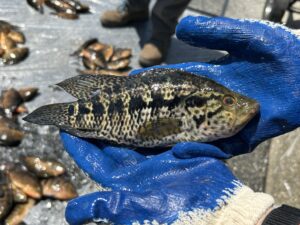
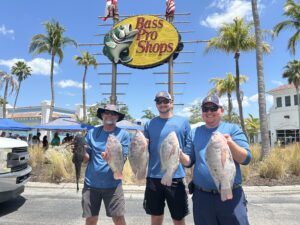
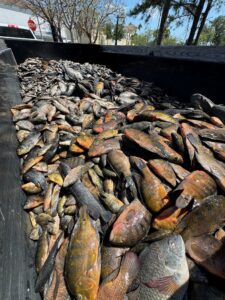
This annual event combines community engagement, citizen science, and conservation action. Anglers remove invasive freshwater fish while supporting research efforts that would not be possible without public participation. During the 2025 roundup—the most impactful to date—144 anglers removed 16,736 invasive fish weighing a combined 4,939 pounds, representing 16 different invasive species. The largest fish brought to the weigh-in was a 5.4-pound blue tilapia, a commonly spotted retention pond resident.
The roundup has provided important data that has supported a variety of applied research projects, including mercury contamination studies and composting trials. These efforts help scientists better understand the spread of these invaders, public perception studies, contaminant data and potential alternative uses for invasive species.
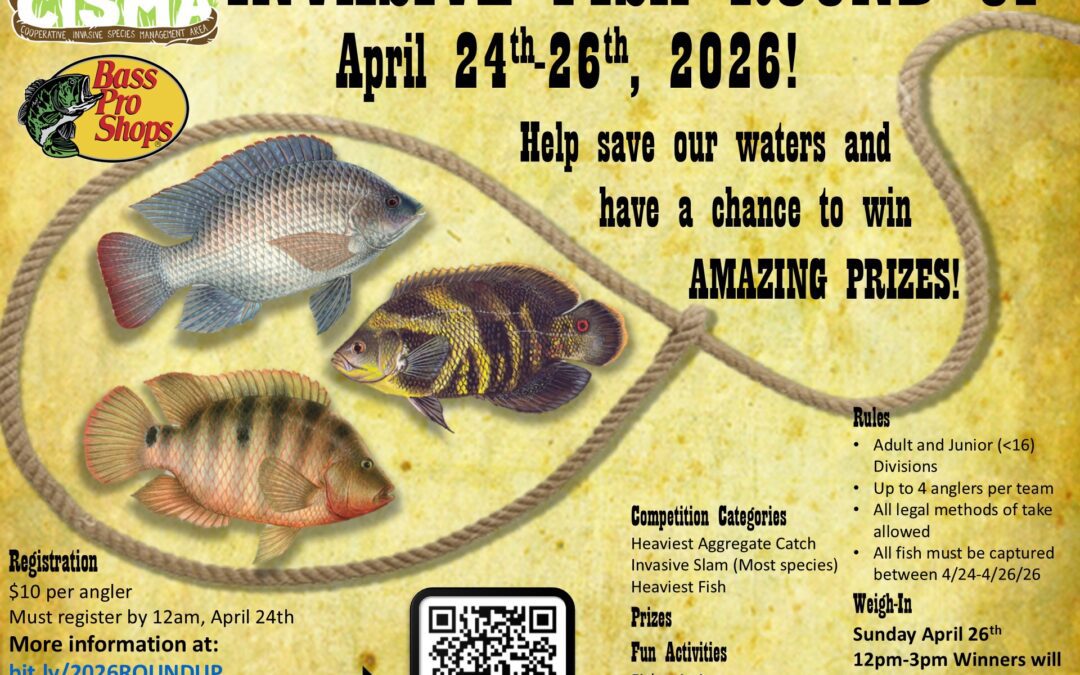
The next SWFL CISMA Invasive Freshwater Fish Roundup will take place April 24-26. The tournament begins virtually on Friday and concludes with a free, public weigh-in at Bass Pro Shops on Sunday. The weigh-in event features educational exhibits, activities for families, and the opportunity to see a wide variety of invasive fish species up close. Registration is available at bit.ly/2026ROUNDUP, and additional photos, data, and research summaries from previous events can be found on the SWFL CISMA Facebook page.
As funding for natural resource programs becomes increasingly limited, volunteer-driven initiatives like the roundup are more important than ever. The event is always looking for support ranging from volunteering at the weigh-in to prize donations. If you would like to get involved, please email sipos624@ufl.edu Education, prevention, research and local action remain our strongest defenses against invasive species.
Submitted by KCB Community Partner:
Michael Sipos
Florida Sea Grant Agent
UF/IFAS Extension Collier County
